
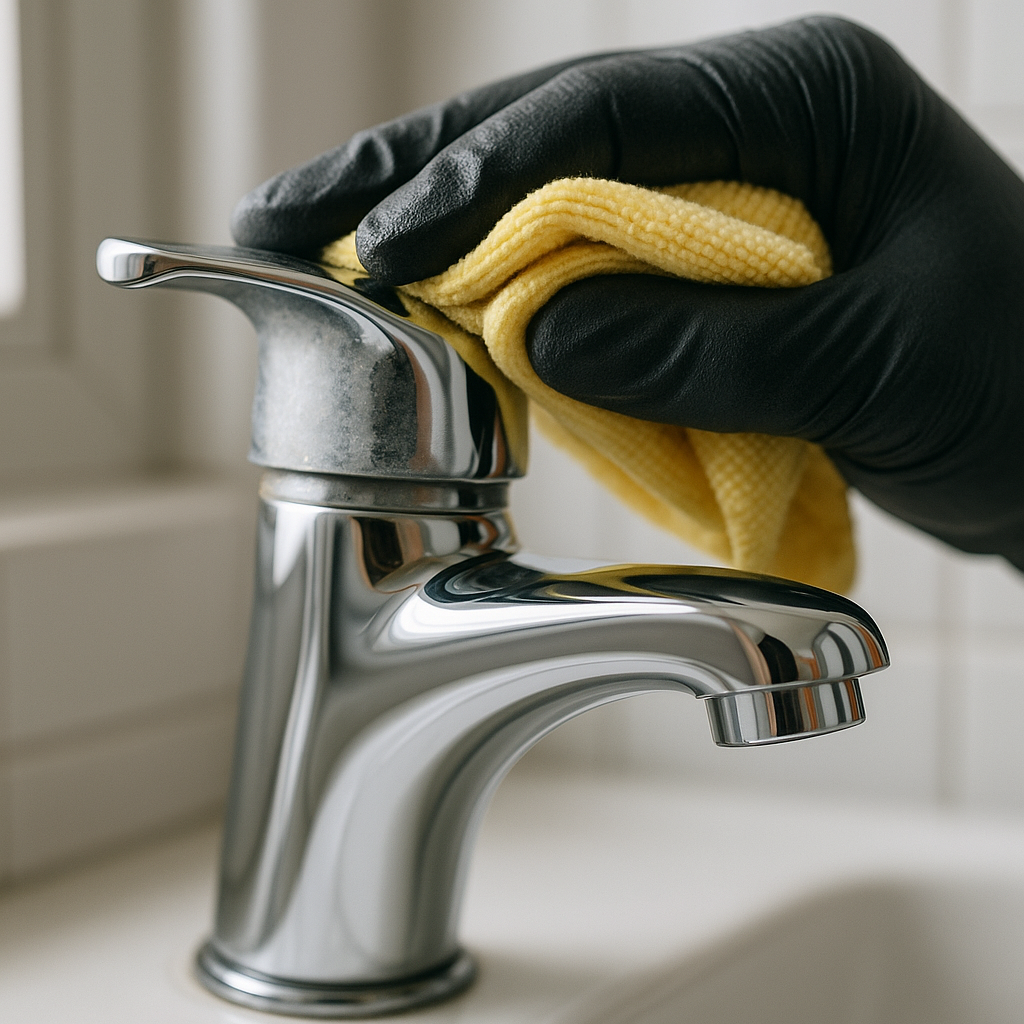
If you have ever scrubbed your shower glass or bathroom tap until your arm ached, only to watch those chalky white rings reappear within days, you are not imagining things — hard water stain removal in Singapore is genuinely one of the toughest recurring problems in HDB, BTO, and condo bathrooms across the island. Singapore’s municipal water supply, while clean and safe to drink, carries enough dissolved minerals to leave stubborn limescale deposits on every surface it touches. Left untreated, these deposits etch into glass, corrode chrome fittings, and turn grout lines an ugly grey-white that no standard cleaning product can budge.
A Real Story — Limescale That Survived Three Different Cleaners in Bishan
A homeowner in a Bishan HDB 4-room flat contacted us after spending two months fighting a losing battle against the mineral stains coating her master bathroom shower enclosure and mixer tap. She had tried two supermarket bathroom sprays, a popular viral TikTok vinegar trick, and even hired a part-time cleaner who scrubbed vigorously but ultimately gave up and told her the glass was permanently damaged. When our team arrived, we quickly identified heavy limescale layering — likely built up over three years without a deep clean — along with mineral deposits that had begun etching the surface of the glass. After our full hard water stain treatment, the shower glass was clear again, the tap gleamed like new, and she messaged us afterward to say it was the first time in years she actually enjoyed using her own bathroom.
Step 1 — Assess the Severity and Surface Type Before Applying Anything
Before our team touches anything, we take five minutes to properly assess what we are dealing with — because not all hard water stains are the same, and the wrong treatment on the wrong surface can cause permanent damage. We check whether the glass has any anti-reflective or nano-coating, whether the tap is solid chrome or a chrome-plated finish, and how deeply the mineral deposits have bonded to the tile grout. In Singapore’s humidity, stains that look mild on the surface are often multi-layered underneath, especially in bathrooms that see heavy daily use. This first step saves us from making the common mistake of going in too aggressively or not aggressively enough.
Step 2 — Apply the Right Descaling Agent to Each Surface
Different surfaces in your bathroom require different descaling approaches, and this is where most DIY attempts go wrong. Our team uses professional-grade, pH-appropriate descalers matched to each material — never a one-size-fits-all spray that risks dulling your fittings or weakening grout.
- Chrome and stainless steel taps: we apply a targeted acid-based descaler at a controlled concentration, left to dwell for several minutes before gentle agitation — never abrasive scrubbing that micro-scratches chrome
- Shower glass panels: we use a specialist glass descaler combined with a non-scratch applicator pad, working in circular motions to lift the mineral film layer by layer without grinding deposits into the surface
- Floor and wall tiles with mineral-stained grout: we apply a grout-safe descaling foam and allow it to penetrate before working it in with a stiff grout brush — essential for HDB bathrooms where grout lines are wide and porous
- Shower heads and mixer cartridge exteriors: we soak or wrap these with a dwell cloth saturated in descaler to break down internal and external mineral buildup that restricts water flow and stains the fixture body
“One thing most homeowners don’t realise is that wiping hard water stains while they are still wet actually spreads the mineral load rather than removing it — the water evaporates and leaves a fresh deposit in an even wider area. Doctor Clean always allows descaling agents to dwell and do the chemical work first, so that physical agitation is the finishing touch, not the main event.”
Step 3 — Work the Stains Methodically From Top to Bottom
Our team always works top to bottom in a bathroom — ceiling-mounted fixtures and shower heads first, then glass panels and wall tiles, then the floor and drain surround last. This matters more than most people think: loosened mineral deposits, descaling solution, and rinse water all flow downward, and if you clean the floor tiles first, you will contaminate them immediately when you rinse the walls. In Singapore bathrooms — particularly the compact wet bathrooms common in 3-room and 4-room HDB flats — surfaces are close together and everything drips onto everything else. We also pay close attention to the silicone seals around shower screens and tub edges, where mineral deposits combine with soap scum and mould to create a layered stain that requires careful hand-detailing rather than bulk spraying. Rushing this stage is the single biggest reason a bathroom looks better immediately after a DIY clean but returns to looking grimy within a week — the deposits in the silicone joints were never fully addressed.
Step 4 — Rinse, Inspect, and Repeat Where Needed
After the descaling agents have done their work and our team has agitated every surface, we rinse thoroughly with clean water and then inspect under good lighting — ideally a torch or handheld light held at a low angle to the glass surface, which reveals any remaining haze or etching that overhead lighting hides. For severe cases, particularly condos in Orchard, Novena, or Buona Vista where bathrooms may not have been deep cleaned for years, we repeat the descaling cycle a second time on stubborn patches rather than accepting a 70% result and moving on. We also check at this stage whether any staining is actually hard water at all — occasionally what looks like limescale is actually soap scum, silicone residue, or even surface damage to the glass, each of which requires a completely different treatment. Getting this diagnosis right at the inspection stage is what separates a professional result from a temporary improvement.
Step 5 — Protect Surfaces to Slow Future Buildup
The final step our team carries out is applying a protective treatment to glass panels and chrome fittings — a water-repellent coating that causes droplets to bead and run off rather than sitting on the surface and evaporating to leave mineral deposits behind. In Singapore’s climate, where bathrooms are used daily and ventilation is often limited, this protective layer can meaningfully extend the time between deep cleans and keep surfaces looking cleaner between sessions. We always advise homeowners to squeegee shower glass after each use and do a quick weekly wipe of taps — simple habits that, combined with our protective finish, make a real visible difference over months.
Why Singapore Homeowners Choose Doctor Clean
We have cleaned hundreds of bathrooms across Singapore — from Tampines BTO bathrooms that have never had a deep clean to luxury condo bathrooms in Sentosa Cove that needed careful handling of premium fittings. Here is what our clients consistently tell us they value most:
- Genuine results on stubborn stains: We do not stop at surface-level cleaning — our team works until the limescale is actually gone, not just reduced, so you can see the difference the moment we finish.
- Safe products for Singapore homes: We use professional descalers that are matched to your specific surfaces, so chrome stays chrome, glass stays clear, and grout is not weakened by the wrong acid concentration.
- Trained, experienced team: Every Doctor Clean technician is trained in surface-specific techniques — no guesswork, no trial-and-error on your bathroom fittings.
- Honest scoping and fast replies: We will tell you upfront if a stain has caused permanent etching that no cleaning can fix, rather than taking your money and leaving you disappointed — and we reply fast on WhatsApp so booking is never a hassle.
Frequently Asked Questions
How long does hard water stain removal take for a standard HDB bathroom?
For a standard HDB 3-room or 4-room bathroom with moderate limescale buildup, our team typically takes between 45 minutes to 1.5 hours to complete a thorough hard water stain treatment. Heavily neglected bathrooms — particularly those that have not been deep cleaned in two or more years — can take longer as multiple descaling cycles may be needed. We always give you a realistic time estimate before we start so there are no surprises.
Can hard water stains permanently damage shower glass?
Yes — if left untreated for a long time, mineral deposits can etch into the glass surface and create a haziness that no amount of cleaning can fully reverse, because the damage is physical rather than just a surface deposit. This is most common in condos and ECs where the shower screen is frameless glass and sees heavy daily use without regular maintenance. Our team will inspect and tell you honestly whether what you are seeing is removable staining or surface etching before we begin work.
Is vinegar safe to use on Singapore bathroom taps and fittings?
White vinegar is a mild acid that can help with light mineral deposits, but it is not strong enough for the layered limescale common in Singapore bathrooms, and it can actually damage chrome-plated fittings, brass fixtures, and natural stone tiles if used too frequently or left to dwell too long. The TikTok bag-of-vinegar-over-the-tap trick is particularly risky — the prolonged contact can strip chrome plating and void fitting warranties. For anything beyond very light surface spots, a professional descaler applied correctly is safer and far more effective.
How often should I book a hard water stain deep clean in Singapore?
For most Singapore households using their bathroom daily, we recommend a hard water stain deep clean every three to six months to prevent heavy mineral buildup from bonding permanently to surfaces. If you have a water softener installed or consistently squeegee your glass after every shower, you may comfortably stretch to every six months. Without any maintenance habits, three months is a safer interval — especially during the dry season when tap water evaporates faster and leaves denser mineral deposits behind.
Do you clean hard water stains in kitchen sinks and on kitchen taps too?
Absolutely — kitchen sinks, mixer taps, and stainless steel surfaces suffer just as much from hard water staining as bathrooms, particularly around the base of the tap where water pools and evaporates repeatedly throughout the day. Our team treats kitchen fixtures with the same surface-matched descaling approach we use in bathrooms, and we take extra care around stainless steel sinks to avoid any treatment that could cause surface discolouration. Just let us know when you book and we will factor the kitchen into the scope.
Ready to get this sorted? WhatsApp Doctor Clean — honest quote, no hard sell, fast reply.
 Doctor Clean