
Singapore’s humidity is relentless — and your sofa feels it before you do. Upholstery cleaning Singapore homeowners keep putting off is often the hidden reason a living room smells musty, looks dull, or triggers allergy flare-ups in the family. Whether you have a cloud-grey fabric sectional in your Tampines BTO or a full-grain leather Chesterfield in your Bukit Timah landed, the approach is completely different — and getting it wrong can cost you the sofa.
A Real Story — The Punggol EC Sofa That Almost Got Thrown Out
A young family in a Punggol EC reached out to Doctor Clean after their three-year-old fabric sectional developed a persistent sour smell and visible grey tide-marks — the aftermath of a toddler’s juice spill that had been scrubbed with a wet cloth and dish soap. They had tried two rounds of DIY foam cleaner from the supermarket, which temporarily masked the odour but pushed the liquid deeper into the cushion fill. When our team arrived, we found mould beginning to form inside the base of one cushion — invisible from the surface but unmistakable up close. After a full hot-water extraction clean with enzyme-based deodoriser and a proper drying protocol, the sofa looked and smelled brand new; the mum told us she finally felt comfortable letting her kids sit on it again.
Step 1 — Assess the Fabric Code and Construction
Before our team touches anything, we identify exactly what we are dealing with. Every upholstered piece has a care tag with a cleaning code — W (water-safe), S (solvent only), WS (either), or X (vacuum only) — and ignoring this single label is how most DIY attempts go wrong. We also look at the construction: tight weave or open weave, foam density, loose cushions versus fixed, and whether the sofa sits on a platform that restricts airflow underneath. In Singapore’s humidity, that underside is often where the first signs of mould and dust mite colonisation appear, so we always check it.
Step 2 — Dry Pre-Treatment and Deep Vacuuming
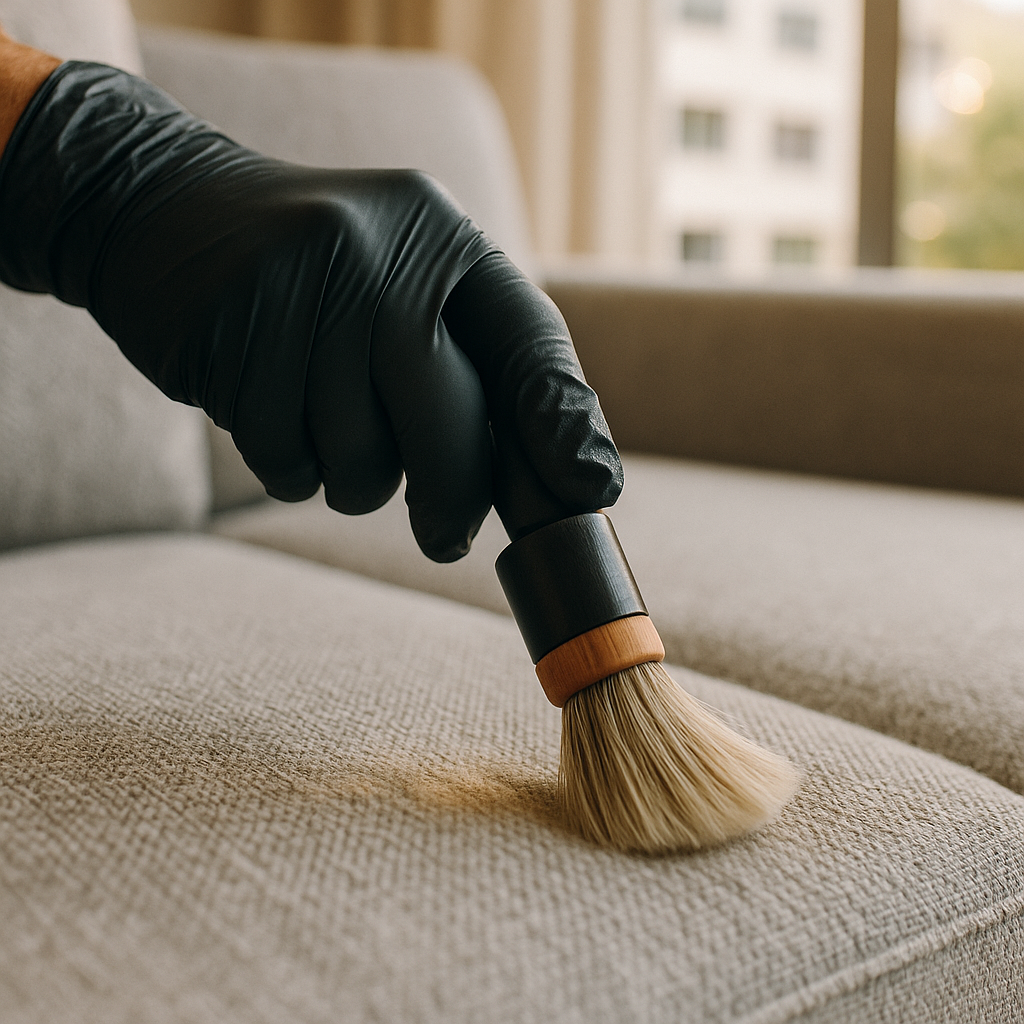
Our next step is always dry before wet. We use a high-suction professional vacuum with a upholstery head to extract loose debris, skin cells, pet dander, and dust mite matter from every seam, crevice, and cushion gap. This step alone makes a visible difference — and it prevents any wet cleaning agent from binding dry soil into the fabric. On fabric sofas we pay particular attention to:
- Seat-cushion seams where crumbs and moisture accumulate fastest in Singapore’s climate
- Back panel folds that trap pet hair and fine dust invisible to the naked eye
- The underside of armrests, which absorb skin oils and are almost never vacuumed by homeowners
“One thing most people don’t realise: vacuuming a fabric sofa before any wet cleaning is not optional — it’s what stops your stains from spreading during extraction. Doctor Clean never skips this step, even on a sofa that looks relatively clean on the surface.”
Step 3 — Fabric Sofa Hot-Water Extraction
For fabric upholstery, Doctor Clean uses a low-moisture hot-water extraction method — the same principle as professional carpet cleaning, scaled and calibrated for upholstery. We apply a pH-balanced pre-spray suited to the specific fabric type, allow it to dwell and break down embedded oils and proteins, then extract it along with the lifted soils using our portable extraction machine. The water temperature is controlled carefully: hot enough to sanitise and dissolve grease, but not so aggressive that it causes shrinkage or colour bleed in more delicate weaves like velvet or linen blends, which are popular in newer Sengkang and Jurong West condos. We finish with an enzyme-based deodoriser that eliminates odour at the molecular level rather than masking it — this is especially important for homes with pets or young children, where biological soiling is common. Drying fans are positioned to accelerate the drying time to two to four hours, because leaving wet upholstery in Singapore humidity overnight is a direct invitation for mould.
Step 4 — Leather Sofa Cleaning and Conditioning
Leather is a completely different conversation, and it is one of the areas where we see the most DIY damage in Singapore homes. Full-grain and top-grain leather must never be cleaned with all-purpose cleaners, baby wipes, or anything containing alcohol — all of which strip the natural oils from the hide and cause the surface to crack or peel within months. Our team uses a dedicated leather cleaner applied with a soft microfibre cloth in gentle circular motions, lifting surface grime, perspiration salts, and the invisible body oil build-up that makes leather look dull and feel sticky in our tropical climate. After cleaning, we apply a professional-grade leather conditioner that restores suppleness and creates a light barrier against future moisture absorption — this step is non-negotiable in Singapore because the humidity cycle of air-conditioning and open windows constantly stresses the leather. For bi-cast or bonded leather — very common in mid-range furniture from local furniture chains — we adjust our approach significantly, as these surfaces are more fragile and do not respond well to conditioning products designed for full-grain hides.
Step 5 — Final Inspection, Deodorising, and Aftercare Advice
Once cleaning is complete, our team does a final walk-around inspection under bright lighting to check for any remaining spots, uneven drying, or areas that need a second pass — we do not pack up and leave until we are satisfied the result meets our standard. We then give every customer practical, Singapore-specific aftercare advice: how often to vacuum their upholstery given their household (pets, kids, and cooking smells all change the frequency), whether to use a fabric protector spray between professional cleans, and how to handle a fresh spill quickly without causing a tide-mark. Our goal is not just to clean your sofa once — it is to help you keep it in good condition for years.
Why Singapore Homeowners Choose Doctor Clean
We have cleaned upholstery across hundreds of Singapore homes — from one-room rental flats in Queenstown to five-room HDBs in Bishan, EC units in Canberra, and landed properties in Serangoon Gardens. Here is what our customers consistently tell us makes the difference:
- Fabric-and-leather expertise under one team: You get technicians who understand both material types and adjust technique on the spot — no guessing, no risk of accidental damage.
- Safe for children, pets, and allergy sufferers: We use enzyme-based and pH-balanced products with no harsh solvent fumes — important in smaller HDB living rooms where ventilation is limited.
- Honest scoping before we start: If a stain is permanent or a leather panel is too far gone to restore, we tell you upfront — not after charging you for a full clean.
- Fast drying and no disruption: Our low-moisture method and drying fans mean your sofa is ready to use the same day, not the next morning.
Frequently Asked Questions
How often should I get my sofa professionally cleaned in Singapore?
For most Singapore households, once every six to twelve months is the right range — but it depends on your lifestyle. Homes with pets, young children, or heavy daily use benefit from a clean every six months, while a guest bedroom sofa in a couple’s condo can go longer. The higher humidity in Singapore also means dust mites and mould spores accumulate faster than in cooler climates, so erring on the side of more frequent cleaning is genuinely worth it for allergy sufferers.
Can you remove curry or food stains from a fabric sofa?
In most cases, yes — especially if the stain has not been scrubbed or treated with the wrong product first. Curry and oil-based food stains respond well to our enzyme pre-spray and hot-water extraction process. If a homeowner has already used bleach, dish soap, or heavy scrubbing before we arrive, the outcome is less predictable, which is why we always recommend calling us before attempting DIY treatment.
Is leather sofa cleaning worth it, or should I just buy a new one?
In our experience, professional cleaning and conditioning can add years to a leather sofa’s life and restore a surface that looks far gone. Unless the leather is structurally cracked through to the foam or the bonded layer is peeling in large sections, a professional clean almost always makes economic sense compared to replacing a sofa. We are happy to assess your sofa honestly over WhatsApp photos before you book.
Do you clean sofas on-site or do you take them away?
Doctor Clean cleans all upholstery on-site at your home — no dismantling, no transportation, no waiting days to get your furniture back. Our portable equipment is brought directly to your HDB, condo, or landed property, and the entire process is completed within a few hours depending on the size and number of pieces.
Ready to get this sorted? WhatsApp Doctor Clean — honest quote, no hard sell, fast reply.
 Doctor Clean