If you’ve ever booked a regular home cleaning and then panicked the week before handing back your HDB flat or condo unit, you’re not alone — tenancy cleaning vs regular cleaning Singapore is one of the most misunderstood distinctions we deal with every week at Doctor Clean. The two services look similar on the surface, but they are built for completely different outcomes, and confusing them can cost you your rental deposit. Here’s exactly what separates them, based on our experience cleaning hundreds of Singapore homes across every property type.
A Real Story — A Clementi HDB Tenant Who Nearly Lost Her Deposit
A tenant renting a 4-room HDB flat in Clementi called us three days before her lease ended, frustrated and a little desperate. She had been booking monthly regular cleaning sessions for two years and assumed the flat was in good shape — but when her landlord came for the pre-inspection, he flagged grease-caked hood filters, limescale-coated bathroom tiles, mould behind the washing machine, and stained grout throughout the kitchen. She’d been maintaining the surface cleanliness, but deep grime had been quietly accumulating in every corner the regular cleaner never touched. Our team went in for a full end-of-tenancy package, spending close to six hours on the unit, and when the landlord returned for the final handover, he signed off with zero deductions. She told us she wished she’d understood the difference a year earlier — she would have booked a deep clean every six months instead of assuming regular visits were enough.
Step 1 — Assess the Property Against Tenancy Standards
Before our team touches anything on a tenancy clean, we do a structured walk-through of the entire unit using a handover-grade checklist — not a general cleanliness checklist, but one that mirrors what Singapore landlords and property agents actually inspect. We look at every surface, fixture, and fitting the way a landlord would: hood filters, grout lines, toilet bowl undersides, window tracks, cabinet interiors, and the backs of appliances. This assessment stage simply doesn’t exist in a regular home cleaning booking, where the assumption is that the home is lived in and the goal is maintenance, not restoration. Knowing what we’re up against in the first ten minutes shapes every decision we make for the rest of the job.
Step 2 — Target the Areas Regular Cleaning Never Reaches
This is the biggest practical difference between the two services, and it’s where most tenants get caught out. Regular cleaning keeps your home looking tidy on a week-to-week basis — floors mopped, surfaces wiped, bathrooms freshened. Tenancy cleaning goes into the spaces that regular cleaning skips by design:
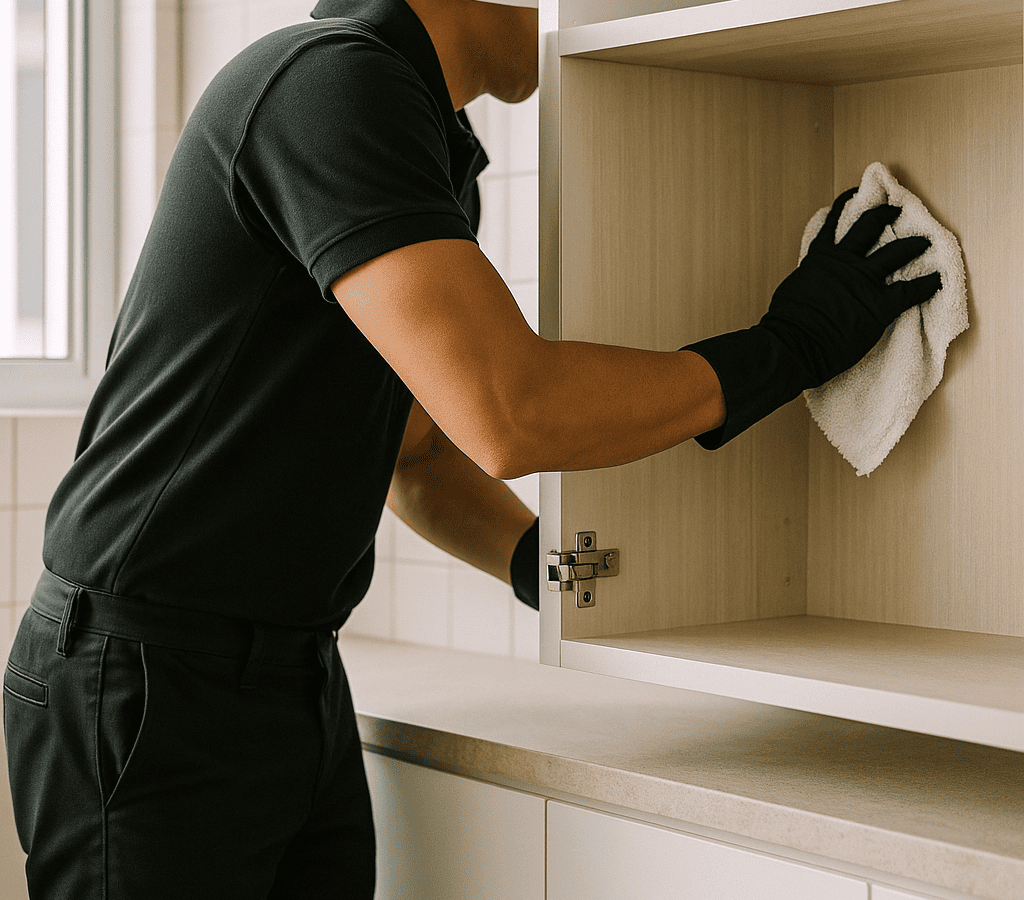
- Inside kitchen cabinets, drawers, and the interior of the oven and microwave
- Extractor hood filters, the top of door frames, ceiling fan blades, and light fixture covers
- Window tracks, sliding door channels, and the rubber seals around bathroom fixtures
- Behind and underneath large appliances like the fridge, washing machine, and dryer
- Grout lines, tile edges, and silicone seals in bathrooms and kitchens
“One thing most tenants don’t realise is that Singapore landlords and their agents often inspect cabinet interiors and hood filters as a standard part of handover — these are the two areas that fail most often, and they’re never part of a regular cleaning scope. Doctor Clean always includes them in tenancy packages because they’re non-negotiable for deposit recovery.”
Step 3 — Deep Clean Bathrooms to Handover Standard
Bathroom cleaning in a tenancy context is a completely different beast from a regular wipe-down. In our experience cleaning units across Tampines, Jurong East, Bishan, and Buona Vista, the bathroom is the single most common reason a landlord withholds part of a deposit — specifically limescale on tap fittings, yellow staining inside the toilet bowl, soap scum on glass shower panels, and mould on silicone grout. Singapore’s humidity accelerates all of these problems, and even a well-kept bathroom can look grimy after two or three years of residency. Our team uses descaling agents on tap heads and shower fittings, scrubs the toilet bowl under the rim and around the base, and removes mould from silicone seals where possible — some severe mould penetration in older HDB bathrooms may require resealing, which we flag clearly upfront. The goal is not just a clean bathroom; it’s a bathroom that passes a close-up landlord inspection.
Step 4 — Restore the Kitchen to Move-In Condition
The kitchen is the other major battleground in any tenancy handover, and it’s where the gap between regular cleaning and tenancy cleaning is most visible. Regular cleaning keeps the countertops and sink clean, but it doesn’t degrease the inside of the hood, scrub the burner grates and drip pans, clean inside the oven cavity, or wipe down the interior walls of every cabinet. In a tenancy clean, we treat the entire kitchen as a restoration project — removing built-up grease from every surface it has migrated to over months or years of cooking. Singapore kitchens, especially in older HDB flats in areas like Toa Payoh, Queenstown, and Ang Mo Kio, often have decades of layered grime on hood vents and behind stoves that takes time and the right chemistry to remove safely. We use commercial-grade degreasers applied with dwell time rather than just wiping on contact, which is what produces the visible difference between a tenancy clean and a quick wipe-over.
Step 5 — Final Inspection and Photo Documentation
Once the cleaning is complete, our team does a second walk-through of the entire unit to check every flagged area against the opening assessment — this is a step that simply doesn’t exist in regular cleaning because there’s no handover standard to meet. We also encourage tenants to take timestamped photos of every room and fixture immediately after our clean, before the landlord’s inspection, as this provides a clear record in case of any dispute. Doctor Clean can also provide a job completion record on request, which some tenants and agents find useful when there’s any back-and-forth about the condition of the unit.
Why Singapore Homeowners Choose Doctor Clean
Whether it’s a one-off tenancy clean before handing back the keys or a regular maintenance booking for your own home, Doctor Clean is built around one thing: results you can actually see and verify. Here’s what our customers consistently tell us makes the difference:
- Handover-grade thoroughness: Our tenancy cleaning checklist is built around what Singapore landlords and property agents actually inspect — not a generic cleaning list, so you’re not paying for things that don’t move the needle on your deposit.
- Singapore property knowledge: We’ve cleaned HDB 3-rooms in Yishun, EC units in Sengkang, landed homes in Serangoon, and shoebox condos in the CBD — we know how different property types accumulate grime and what each handover standard looks like.
- No harsh chemicals on sensitive surfaces: Our team selects cleaning agents based on the surface — marble countertops, vinyl flooring, and glass shower panels all need different chemistry, and we get this right every time without causing damage.
- Transparent scope, honest pricing: We tell you upfront what’s included, what’s not, and whether there are any problem areas — like severe mould or grease build-up — that may affect the outcome. No surprises after the job is done.
Frequently Asked Questions
Is tenancy cleaning the same as spring cleaning in Singapore?
They overlap, but they’re not the same thing. Spring cleaning is typically done in a lived-in home to refresh and declutter — it’s thorough, but it’s not measured against a handover standard. Tenancy cleaning is specifically structured to meet the condition a landlord expects when you return the keys, which means it covers areas like cabinet interiors, appliance interiors, and grout that spring cleaning may or may not include depending on who you book. If you’re moving out, always book a service that’s explicitly described as end-of-tenancy or move-out cleaning.
How much does tenancy cleaning cost in Singapore compared to regular cleaning?
Regular home cleaning in Singapore typically runs from $80 to $150 for a standard session depending on flat size and frequency. Tenancy cleaning costs more — typically $250 to $500 for an HDB flat and $400 to $800 or more for a condo unit — because it involves significantly more time, specialised chemicals, and a much broader scope of work. The cost is almost always worth it when weighed against the risk of losing hundreds or thousands of dollars from your deposit deductions.
Do I need tenancy cleaning if my flat is already quite clean?
In most cases, yes — because “clean to live in” and “clean to hand back” are genuinely different standards. Even a well-maintained flat will typically have limescale in the bathrooms, grease in the hood filters, and grime in the window tracks that regular upkeep doesn’t address. A professional tenancy clean gives you the documented, thorough result that protects your deposit and removes any ambiguity during the landlord inspection.
How long does a tenancy clean take for an HDB flat in Singapore?
For a typical 3-room HDB flat, expect around 3 to 4 hours with a two-person team. A 4-room or 5-room flat usually takes 5 to 7 hours depending on the condition. Heavily soiled units — particularly kitchens with years of grease build-up or bathrooms with significant mould — can take longer, and our team will flag this after the initial walk-through so you’re never caught off guard by the timeline.
Ready to get this sorted? WhatsApp Doctor Clean — honest quote, no hard sell, fast reply.
Tags
 Doctor Clean