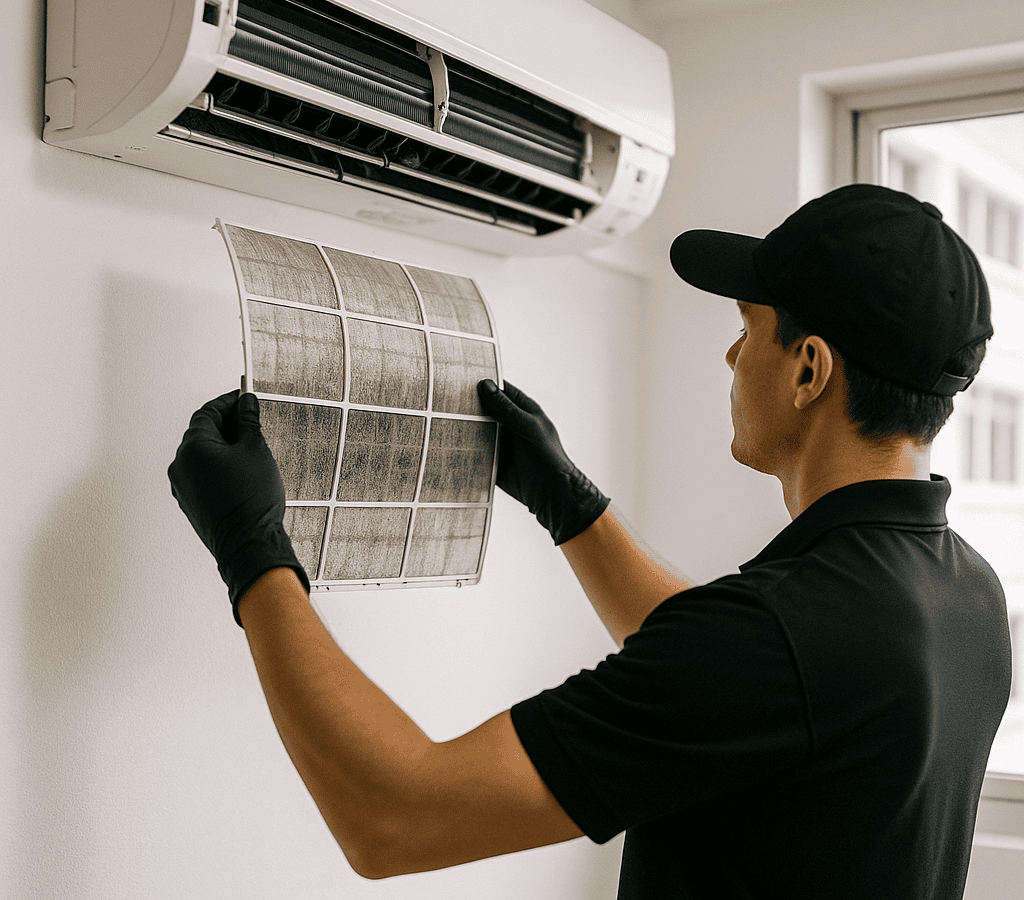
Singapore’s heat means most of us run our aircon units seven, eight, sometimes ten hours a day — and that constant use turns your indoor air handler into a slow-growing collection of dust, mould spores, and bacteria that gets blown back into the room every single cycle. Aircon cleaning Singapore homeowners keep delaying is one of the most common requests our team receives, usually after someone starts waking up with a scratchy throat or notices a faint musty smell they can’t locate. If your unit hasn’t been properly cleaned in over six months, there’s a very good chance you’re breathing air that has passed through a filter coated in grime.
A Real Story — The Punggol BTO That Smelled Fine Until It Didn’t
Last year we got a call from a couple in a Punggol BTO 4-room flat who had just completed their renovation and moved in six months prior. They’d had the aircon installed brand new during the reno, so they assumed cleaning wasn’t necessary yet — it was new, after all. What they didn’t realise was that the post-renovation dust from sanding, drilling, and painting had been pulled straight into the system during the initial weeks of use, compacted behind the filter, and started growing mould in Singapore’s relentless humidity. By the time our team arrived, the evaporator coil was coated in a grey-green film and the couple told us they’d both been sneezing constantly since moving in — within two days of our full chemical wash, they messaged us to say the difference was immediate and they finally felt at home.
Step 1 — Assess the Unit Before Touching Anything
Before our team touches anything, we do a full visual inspection of every aircon unit in the home — checking the filter condition, the drainage tray, the condition of the louvers, and any visible staining around the unit on the wall or ceiling. This matters because a unit that’s leaking or showing heavy mould growth needs a different approach than one that’s simply dusty from routine use. In our experience cleaning hundreds of Singapore homes from Tampines to Clementi to Holland Village, skipping this assessment step is exactly why DIY cleaning so often misses the actual problem and just pushes dirt deeper into the coil.
Step 2 — Remove, Rinse, and Inspect Every Filter
We remove every filter carefully — shaking or blasting a filter while it’s still inside the unit sends accumulated dust straight onto the evaporator coil and into the drainage pan, which is a mistake we see constantly when homeowners try to do this themselves. Our team takes each filter out and rinses it thoroughly under running water, using a soft brush to work through the mesh without warping it, then allows it to dry fully before reinstallation. After cleaning, we hold each filter up to the light to check for tears, collapsed sections, or permanent blockage that means the filter should be replaced entirely rather than re-used.
- Wash filter under running water — never use compressed air indoors near the coil
- Check the drainage tray for standing water, slime, or blockage in the drain pipe
- Inspect the evaporator coil face for dust caking, mould patches, or bent fins
“Most Singapore homeowners don’t realise that cleaning the filter alone only addresses about 20% of the problem — the evaporator coil, drainage tray, and blower fan wheel accumulate far more biological growth and are almost never touched in a basic aircon service. Doctor Clean always inspects all three before deciding whether a standard clean or a full chemical wash is the right call.”
Step 3 — Clean the Evaporator Coil and Blower Fan
The evaporator coil is where the real work happens, and it’s also where most of the biological growth lives in Singapore’s climate. Our team applies a professional-grade coil cleaner that breaks down the compacted dust and mould without corroding the aluminium fins — we let it dwell for the right amount of time, then flush it carefully so the residue drains out cleanly through the drainage line. The blower fan wheel — the cylindrical fan that spins inside the casing — is often the single dirtiest component in the whole unit, and in units that haven’t been cleaned in over a year, we regularly remove what looks like thick grey felt wrapped around every blade. We use a specialised brush and cleaning solution to work through each blade individually, because a dirty blower doesn’t just reduce airflow — it actively flings mould particles into the room air every time the fan runs. This step alone is the reason many of our customers tell us their unit suddenly feels like it’s blowing colder after a proper clean — it’s not imagination, it’s airflow restored.
Step 4 — Clear the Drainage Line and Tray
A blocked drainage line is one of the leading causes of aircon water leaking onto ceilings and walls in Singapore HDB flats and condos, and it’s almost always caused by biological slime building up in the pipe over time rather than any mechanical fault. Our team flushes the drain line with water and, where necessary, uses a wet vacuum to pull a blockage clear from the tray end — we also clean the tray itself thoroughly because a slimy tray is a mould reservoir that re-contaminates the coil. For homes in older estates like Toa Payoh, Queenstown, or Ang Mo Kio where units may have been running for five or more years without a proper drain flush, we sometimes find the tray is almost completely obstructed. Leaving this unaddressed means it’s only a matter of time before water finds another exit — usually through the ceiling of the room below in a landed home, or creating a damp patch that damages freshly painted feature walls in a newer condo.
Step 5 — Final Check, Reassembly, and Run Test
Once everything is cleaned, dried, and reassembled, our team runs each unit for ten to fifteen minutes and checks that the airflow is strong and even across all louver positions, the temperature is dropping at a normal rate, and — critically — there is no musty or burning smell coming from the vents. We also wipe down the external casing, the remote sensor eye, and the area around the unit on the wall to leave the whole installation looking fresh. Before we leave, we give the homeowner a straight assessment of which units, if any, are approaching the end of their serviceable life or need a refrigerant top-up — no upsell pressure, just honest information so you can plan ahead.
Why Singapore Homeowners Choose Doctor Clean
We’ve cleaned aircon units in everything from 3-room HDB flats in Bedok to penthouse condos in Orchard, and what keeps customers coming back is simple: we do the job properly the first time. Here’s what that actually means for you:
- Genuinely cleaner air: Our full clean addresses the coil, blower, filter, and drainage — not just the filter wipe that most basic services stop at — so you notice a real difference in air quality and smell within hours.
- No more water leaks: Clearing the drainage line properly eliminates the number-one cause of aircon water damage in Singapore homes, saving you the cost and stress of a ceiling repair.
- Trained team, safe products: Our team uses professional coil cleaners that are safe for aluminium fins and won’t leave chemical residue in the airstream — important if you have young children or elderly family members at home.
- Honest scheduling advice: We tell you exactly how often your specific units need cleaning based on usage, environment, and unit age — not a blanket upsell schedule that benefits us more than you.
Frequently Asked Questions
How often should I clean my aircon in Singapore?
For most Singapore households running their aircon daily, we recommend a proper clean every three to four months — that’s the reality of our humidity and dust levels, even in newer BTO flats. If you have pets, cook frequently, or live near a main road with traffic dust, every two to three months is more appropriate. Units that are only used occasionally, like a guest room aircon, can go slightly longer but should still be checked every six months because mould grows even when the unit is idle in our climate.
What’s the difference between aircon servicing and aircon cleaning?
Aircon servicing in Singapore typically refers to a basic maintenance visit — filter cleaning, visual check, and sometimes a gas pressure reading — which is important but doesn’t address mould or biological buildup inside the coil and blower. Aircon cleaning, especially a chemical wash, goes much deeper: the coil is chemically treated, the blower fan is scrubbed, and the drainage system is properly flushed. If your unit smells musty or your allergies have worsened at home, a standard service won’t solve it — you need a proper clean.
Can dirty aircon make you sick in Singapore?
Yes, genuinely — a mould-coated evaporator coil or a clogged blower fan is continuously circulating mould spores, dust mite debris, and bacteria through your living space every time the unit runs. In Singapore’s enclosed, air-conditioned homes where windows are rarely opened, this indoor air quality issue is a real health concern, particularly for children, the elderly, and anyone with asthma or rhinitis. Our team regularly hears from customers that persistent morning sneezing or unexplained coughs clear up within days of a thorough aircon clean.
Is a chemical wash necessary, or is a regular clean enough?
A regular clean — filter wash, coil rinse, tray wipe — is sufficient for units that are serviced every three months and haven’t been neglected. But if your unit hasn’t been properly cleaned in six months or more, if there’s visible mould on the coil face, or if the unit smells even after a standard service, a chemical wash is the right call because it breaks down the compacted biological matter that water alone won’t shift. Doctor Clean will always assess your unit honestly and recommend only what’s actually needed — we’ll tell you if a regular clean is sufficient.
Ready to get this sorted? WhatsApp Doctor Clean — honest quote, no hard sell, fast reply.
Tags
 Doctor Clean