
Cigarette smell removal Singapore is one of the most challenging odour jobs we take on — and also one of the most satisfying to solve. In Singapore’s humid climate, tobacco smoke doesn’t just linger in the air; it bonds with wall paint, soaks into fabric, and embeds itself deep into upholstery foam, making DIY solutions almost always fall short. If you’ve just taken over a resale HDB flat, moved into a unit where the previous tenant smoked, or are dealing with a family member’s habit, this guide explains exactly how Doctor Clean approaches the problem.
A Real Story — Resale HDB in Toa Payoh, heavy smoker unit
A young couple who had just collected the keys to their resale 4-room HDB flat in Toa Payoh contacted us in a panic — even after repainting one wall themselves, the sharp, stale tobacco smell returned within days whenever humidity spiked. They had tried air fresheners, baking soda on the sofa, and an ioniser from Lazada, but nothing lasted more than a few hours. Our team arrived, assessed the full scope including walls, curtains, the fabric sofa, and the bedroom mattress, and completed a targeted odour-removal treatment over one full day. When the couple returned that evening, the wife messaged us to say it was the first time the flat had smelled like a home — not an ashtray — and she finally felt excited about moving in.
Step 1 — Identify every odour source in the unit
Before our team touches a single surface with any product, we walk the entire unit with trained noses and a systematic checklist. Cigarette smell in Singapore homes is deceptive — what smells strongest is rarely the only source. We check wall surfaces (especially near windows and balcony doors where smokers typically stood), ceiling corners where tar residue accumulates, fabric sofas, curtains, mattresses, timber furniture, and even the inside of built-in wardrobes. Skipping this audit is exactly why DIY attempts fail — most people treat the obvious spots and miss the hidden ones entirely.
Step 2 — Pre-treat walls and hard surfaces
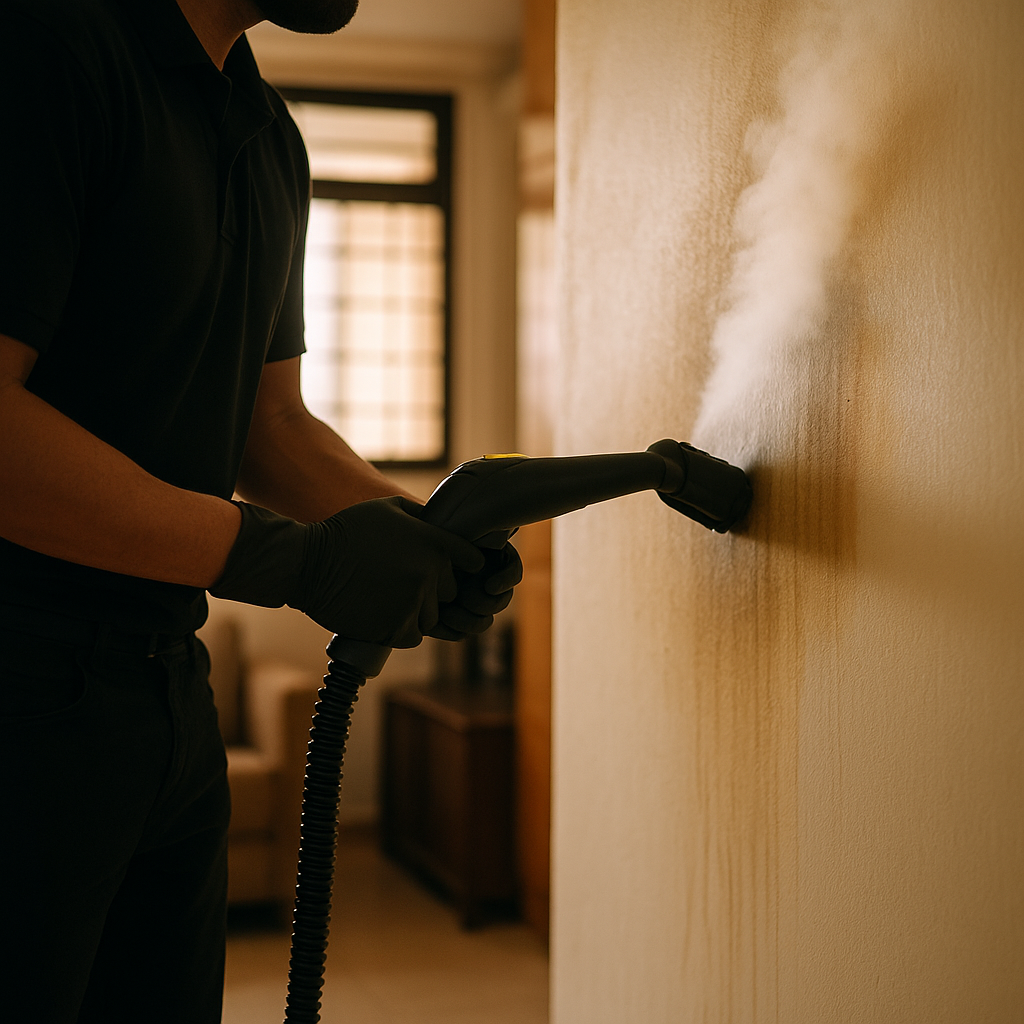
Nicotine and tar create a thin, oily film on walls that regular mopping or wiping cannot break down. Our team uses professional-grade alkaline degreasers that are safe for HDB and condo painted surfaces, applied systematically from ceiling to floor in overlapping sections. This step is non-negotiable — if you skip the wall treatment and go straight to fabric, the smell will simply redeposit itself from the walls back into your freshly cleaned upholstery within weeks. We pay particular attention to these surfaces:
- Wall areas directly behind sofas and beds where smoke concentration is highest
- Ceiling fans, light fixtures, and aircon louvre vents which trap tar particles
- Timber furniture surfaces, door frames, and built-in cabinet interiors
“One thing most people don’t realise is that repainting over a smoke-affected wall without degreasing it first is one of the most common and expensive mistakes in resale HDB renovations — the smell bleeds through fresh paint within months. Our team always treats the wall surface before any repainting is considered.”
Step 3 — Deep clean all soft furnishings and upholstery
Fabric is where cigarette smell truly entrenches itself in a Singapore home, and this is the step that requires the most care and the right equipment. Our team uses hot water extraction combined with professional odour-neutralising agents — not masking fragrances — to flush tobacco compounds out of sofa cushions, fabric headboards, curtains, and mattresses. In our experience cleaning hundreds of Singapore homes, fabric sofas are almost always the single largest reservoir of cigarette odour in a unit, because the foam inside cushions can hold years’ worth of absorbed smoke. We treat the fabric surface, work product into the foam layer through the upholstery, and then extract the residue with our wet-dry commercial equipment, leaving surfaces damp but not wet, and fully dry within a few hours with good airflow. For curtains, we typically recommend removing them for a dedicated curtain steam clean rather than treating them in situ, because tobacco compounds in curtain fabric are dense and need full immersion-level treatment to be properly neutralised.
Step 4 — Apply enzymatic odour neutraliser to the full space
Once all surfaces and fabrics have been physically cleaned, our team applies a professional enzymatic odour neutraliser across the entire unit — walls, floors, furniture, and soft furnishings. Enzymatic products work by breaking down the organic molecules that create odour at a molecular level, which is fundamentally different from an air freshener or an ioniser that simply competes with or masks the smell. We use a fine-mist fogger for this stage, which allows the neutraliser to reach corners, ceiling edges, inside wardrobes, and areas behind furniture that would be impossible to treat by hand. This fogger application is one of the most important reasons why Doctor Clean’s cigarette smell removal results last — we’re not covering up the problem, we’re eliminating the chemical compounds that cause it. The unit is then ventilated thoroughly before we do a final walkthrough assessment.
Step 5 — Final check and maintenance advice for Singapore’s humidity
Our team always finishes with a full walkthrough of the treated unit, checking every room and built-in space to confirm the odour is gone rather than simply reduced. We also give every customer practical advice specific to Singapore’s humidity — because at 80–90% relative humidity, any residual odour compounds left untreated will reactivate, which is why cutting corners at any earlier step creates a relapse. We advise on aircon filter cleaning frequency, the use of activated charcoal dehumidifiers in wardrobes, and how long to ventilate the unit daily to maintain the clean result long-term.
Why Singapore Homeowners Choose Doctor Clean
We’ve handled cigarette smell removal in resale HDB flats, executive condos in Jurong, landed properties in Serangoon, and commercial offices across the CBD — and the feedback we hear most often is that our results actually last. Here’s what clients consistently tell us sets Doctor Clean apart:
- Genuine odour elimination, not masking: We use enzymatic neutralisers and hot water extraction — not fragrances that wear off in 48 hours. Customers tell us the smell is gone, not just covered.
- Full-unit approach built for Singapore homes: We treat walls, fabric, furniture, and aircon vents together — because in Singapore’s humidity, leaving any source untreated means the smell comes back within weeks.
- Safe products for HDB and condo surfaces: Our team uses chemicals that are effective on tobacco residue but safe for painted walls, timber laminate, and fabric upholstery — no bleaching, no damage, no harsh chemical aftermath.
- Transparent scoping with no hard sell: We assess the unit honestly and tell you exactly what needs treating and what doesn’t — if your curtains are fine, we’ll tell you that rather than upsell an unnecessary service.
Frequently Asked Questions
How long does cigarette smell removal take for an HDB flat in Singapore?
For a standard 3-room or 4-room HDB flat with moderate smoke odour, our team typically takes between four and seven hours depending on how many fabric surfaces are involved and the severity of the tobacco staining on walls. Heavier cases — such as units where someone smoked indoors daily for several years — may require a follow-up visit or a two-phase treatment. We always give you an honest time estimate after the initial walkthrough assessment.
Will the cigarette smell really be completely gone, or will it come back?
When we treat the full scope — walls, fabrics, furniture, and vents — using our enzymatic fogger and hot water extraction process, the results are long-lasting and not a temporary mask. However, if active smoking continues in the unit after treatment, or if Singapore’s humidity reactivates untreated hidden sources we weren’t given access to (like sealed-up wardrobes or a room left out of scope), there can be partial recurrence. We’re always transparent about this during assessment.
Can you remove cigarette smell from a fabric sofa without damaging it?
Yes — this is one of the most common jobs our upholstery team handles. We assess the fabric type first (microfibre, velvet, and linen each require a different approach) and use extraction methods that clean deep into the foam without over-wetting the material. Most fabric sofas are dry enough to sit on within three to four hours after treatment.
Is cigarette smell removal in Singapore expensive?
Pricing depends on the size of the unit, the number of fabric surfaces involved, and the severity of the smoke damage — a light treatment for a small condo will cost significantly less than a full-unit deep clean in a heavily smoked-in 5-room HDB. Doctor Clean provides honest, itemised quotes via WhatsApp before any work begins, so there are no surprises. We’d rather give you an accurate number upfront than win the job and disappoint you on value.
Ready to get this sorted? WhatsApp Doctor Clean — honest quote, no hard sell, fast reply.
 Doctor Clean