
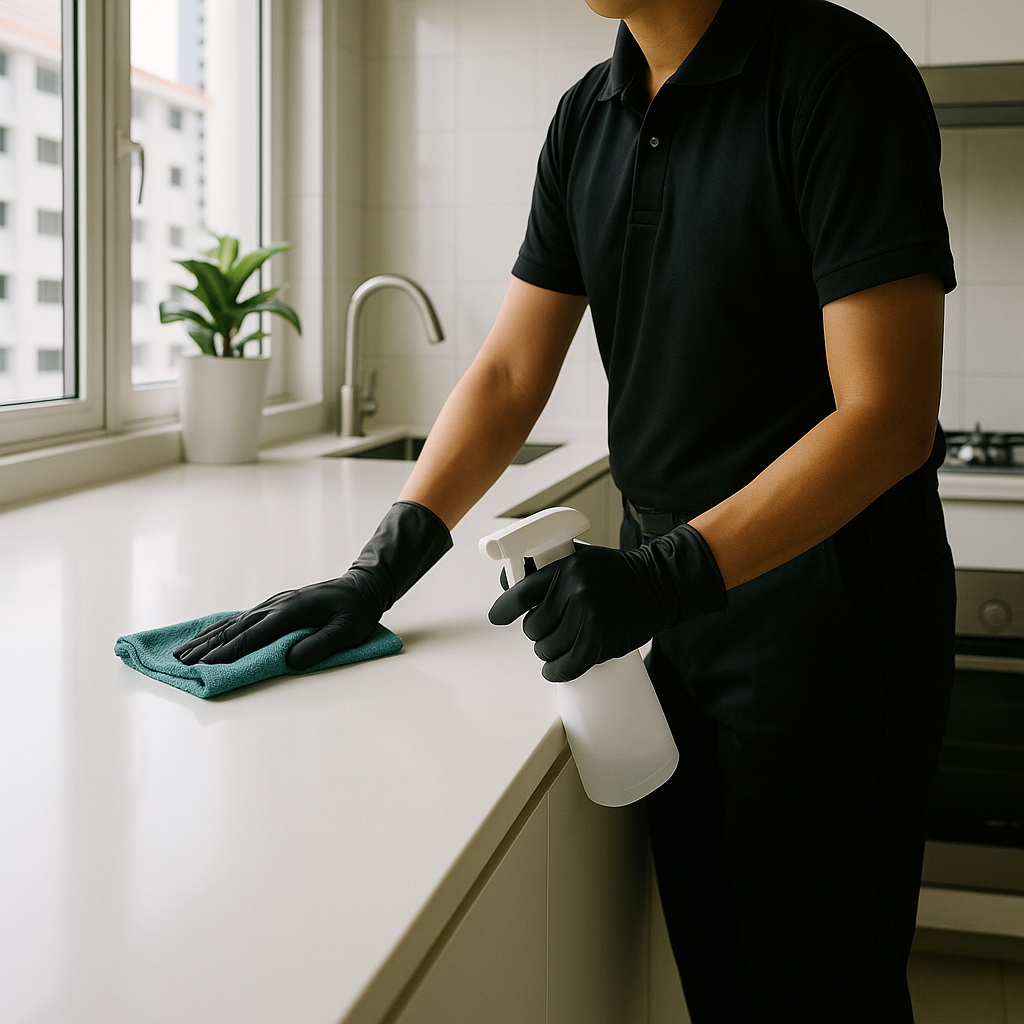
If you’re a landlord in Singapore renting out an HDB flat, condo, or EC, the question of cleaning obligations comes up more often than you’d expect — and the answers aren’t always clear-cut. Landlord cleaning obligations Singapore landlords deal with sit in a grey zone between what the law technically requires, what tenancy agreements actually state, and what tenants genuinely expect when they hand back the keys. Our team at Doctor Clean has helped hundreds of landlords navigate exactly this situation, and in this guide we’re sharing what we’ve seen on the ground.
A Real Story — Tampines HDB landlord caught off guard at handover
Last year, we received a call from Mr Tan, a landlord who had rented out his 4-room HDB flat in Tampines for three years. When his tenants vacated, he assumed the place would be handed back in reasonable condition — his tenancy agreement said “fair wear and tear accepted” and he hadn’t thought much further than that. What he found instead was a kitchen with grease-caked hood filters, bathroom grout black with mould, and a master bedroom carpet that smelled of pet dander. He’d tried negotiating with the tenants, who insisted they had “cleaned before leaving,” but their version of clean and his version were worlds apart. Doctor Clean came in, did a full end-of-tenancy deep clean over six hours, and Mr Tan told us afterwards that he finally felt like he could show the unit to new tenants without embarrassment — and that he wished he’d set cleaning expectations in writing from the start.
Step 1 — Understand what Singapore law actually says
Here’s the honest truth: Singapore does not have a single piece of legislation that spells out a landlord’s specific cleaning obligations in detail. What governs most rental situations is the tenancy agreement itself, alongside general common law principles around habitability and the condition of premises at the start of a lease. The HDB does require that residential premises be maintained in a clean and sanitary condition under the Housing and Development Act, but enforcement at the unit level typically falls between landlord and tenant. In our experience cleaning hundreds of Singapore homes, the biggest disputes arise not because the law is unclear, but because neither party defined “clean” clearly enough before the tenancy began.
Step 2 — Know what a landlord is actually expected to provide
Before a new tenant moves in, there is a widely accepted baseline in Singapore’s rental market — even if it’s not written into statute. Most property agents and experienced landlords understand that the unit should be handed over in a professionally cleaned state. This includes:
- All surfaces wiped down — walls, cabinets inside and out, countertops, and built-in wardrobes
- Bathrooms descaled and disinfected, including toilet bowls, shower screens, and floor tiles
- Kitchen thoroughly degreased, including the stove, hood filters, hob, and inside the oven if applicable
- Floors mopped and any carpet or rug professionally cleaned or shampooed
- Air-conditioning units serviced and filters cleaned, especially critical in Singapore’s humidity
“One thing most landlords don’t realise is that handing over a unit without a professional clean — even if it looks tidy — can backfire badly. If a tenant documents dirty conditions at move-in and later disputes the security deposit deduction, a landlord with no cleaning receipt has very little ground to stand on.”
Step 3 — Get the tenancy agreement to do the heavy lifting
This is the step most landlords skip, and it costs them later. A well-drafted tenancy agreement should clearly state the condition the unit must be returned in at the end of the lease — ideally referencing a professional clean as a requirement, not just a vague standard of cleanliness. Our team regularly works with landlords who ask us to provide a cleaning checklist that can be attached as a schedule to their tenancy agreement, so both parties sign off on exactly what “clean” means. In Singapore’s competitive rental market, particularly in high-demand areas like Bishan, Queenstown, and Jurong East, tenants are savvy — they will photograph everything at move-in, and landlords should do the same. When both sides have a documented baseline, disputes over deposit deductions become far less heated. If the tenancy agreement references a professional end-of-tenancy clean as a tenant obligation, Doctor Clean can provide the service, the receipt, and a post-clean photo record that holds up in any Small Claims Tribunal situation.
Step 4 — Address Singapore-specific cleaning challenges before handover
Singapore’s climate creates cleaning problems that landlords in other countries simply don’t face at the same scale. High humidity means mould grows fast — especially in bathrooms without good ventilation, in BTO flats where the first tenant moved in before the building fully dried out, and in bedrooms with split-unit aircon that hasn’t been serviced regularly. When our team does a landlord handover clean in a Sengkang EC or a Punggol BTO, we always check behind the toilet cistern, under the kitchen sink, and inside built-in wardrobe bases — these are the spots where mould hides and where new tenants will notice within weeks of moving in. Pest issues are another concern: a unit that has been rented to tenants who kept food improperly stored can harbour cockroach activity in drainage gaps and behind kitchen appliances. A proper deep clean before the next tenancy isn’t just about appearances — it’s about handing over a genuinely hygienic space that protects your reputation as a landlord and reduces the chance of complaints down the line.
Step 5 — Document everything before and after cleaning
Whether you’re a first-time landlord in Clementi or a seasoned investor with multiple units across Ang Mo Kio and Bedok, documentation is your best protection. After every landlord handover clean Doctor Clean completes, we encourage clients to do a walk-through with us and photograph the unit in its cleaned state — room by room, surface by surface. This photo record, combined with our cleaning receipt, gives you a clear timestamp of condition that is invaluable if a future tenancy dispute arises. It sounds administrative, but in our experience, the landlords who never have deposit disputes are almost always the ones who treat documentation as part of the handover process, not an afterthought.
Why Singapore Homeowners Choose Doctor Clean
Landlords across Singapore trust Doctor Clean for handover cleans because we understand the specific pressures of the local rental market — tight timelines, difficult-to-clean HDB kitchens, and the high expectations of incoming tenants. Here’s what we actually deliver:
- Thorough, documented handover cleans: We cover every surface and provide a receipt and post-clean photo record that protects landlords in any deposit dispute.
- Singapore climate expertise: Our team knows where mould hides in HDB and BTO units and treats it properly — not just surface-wipes it — so the next tenant doesn’t find it two weeks after moving in.
- No harsh chemicals near fixtures and fittings: We use appropriate cleaning agents for each surface, protecting your flooring, countertops, and fittings from damage that would cost you more to repair.
- Fast turnaround for back-to-back tenancies: We know rental timelines are tight, especially in high-demand neighbourhoods. Our team works efficiently so your unit is ready to show or hand over without delay.
Frequently Asked Questions
Is a landlord legally required to clean a unit before a tenant moves in Singapore?
There is no specific statute in Singapore that mandates a landlord must professionally clean a unit before a new tenancy begins. However, the implied condition of habitability under common law, combined with what most tenancy agreements and property agents expect, means handing over a dirty unit can expose a landlord to complaints, early lease termination claims, or damage to their reputation on rental platforms. In practice, professional cleaning before move-in is the standard — and skipping it creates more problems than it solves.
Can a landlord deduct cleaning costs from the security deposit if the tenant leaves the unit dirty?
Yes, in most cases — provided the tenancy agreement clearly states that the unit must be returned in a professionally cleaned condition. If the agreement is vague, a landlord can still make a case based on the documented condition at move-in versus move-out, which is why photo evidence and a cleaning receipt at the start of the tenancy matters so much. Singapore’s Small Claims Tribunal handles these disputes regularly, and clear documentation almost always determines the outcome.
How much does a landlord handover cleaning cost in Singapore?
Pricing depends on the unit size and condition. A standard 3-room HDB clean typically starts from around $180–$250, while a larger 5-room or condo unit in worse condition can run higher. Doctor Clean provides honest, transparent quotes based on actual unit size and what needs to be done — WhatsApp us with your unit type and we’ll give you a real number quickly.
What should be included in an end-of-tenancy clean in Singapore?
A proper end-of-tenancy clean should cover the full kitchen including hood, hob, oven, and cabinet interiors; all bathrooms descaled and disinfected; floor cleaning throughout; aircon filter cleaning; and wipe-down of all built-in furniture, switches, and door frames. Our team also cleans areas that often get skipped — inside wardrobes, behind appliances, and the tops of kitchen cabinets — because incoming tenants notice these spots immediately. If there’s a specific condition your tenancy agreement references, share it with us and we’ll clean to that standard.
Ready to get this sorted? WhatsApp Doctor Clean — honest quote, no hard sell, fast reply.


 Doctor Clean