
If you share your HDB flat or condo with a dog or cat, you already know the smell we’re talking about — that warm, settled scent that hits guests the moment your front door swings open. Pet odour removal in Singapore is genuinely harder than most owners expect, because our humidity traps dander, urine crystals, and bacteria deep into fabric and flooring before you even notice there’s a problem. Our team at Doctor Clean has cleaned hundreds of pet-friendly homes across the island, and we want to walk you through exactly how we approach it.
A Real Story — The Toa Payoh cat owner who couldn’t sell her flat
A homeowner in Toa Payoh contacted us just weeks before her HDB 4-room flat was due for viewings — she had two cats, and despite weekly mopping and regular vacuuming, the unit had a persistent ammonia-like odour that she had genuinely stopped noticing herself. She had tried enzyme sprays from the pet shop and even repainted one wall, assuming the smell was coming from there. The sprays masked the odour for a day or two, but it always came back stronger after the next rainy afternoon. Our team came in, identified the primary sources — a section of grout along the toilet corridor, the sofa base fabric, and the underside of her bedroom curtains — treated each surface with the correct chemistry, and extracted the residue properly. Her first viewing that weekend ended in an offer, and she told us she cried a little when she walked back in after we left because the flat finally smelled like a home again.
Step 1 — Identify every odour source before touching anything
Before our team touches a single surface, we do a full walkthrough of your home with fresh eyes — and sometimes a UV torch, which lights up dried urine deposits on floors, skirting boards, and upholstery that are completely invisible to the naked eye. In Singapore homes, pets tend to have favourite corners, and those spots accumulate layers of odour over months or years rather than in a single incident. We take notes, photograph problem areas, and discuss the findings with you openly so there are no surprises when we quote or begin work. Skipping this step is exactly why DIY treatments so often fail — you treat the wrong spot and wonder why the smell returns.
Step 2 — Pre-treat all affected surfaces with the right chemistry
Not every surface gets the same treatment, and using the wrong product can actually set a stain or permanently bond urine salts into porous flooring. Our team pre-treats each identified zone according to what it’s made of and how long the contamination has been there. Here’s what we typically address in a Singapore pet home:
- Fabric sofas and armchairs — enzyme pre-spray applied into the fill, not just the surface, to break down uric acid crystals at depth
- Timber laminate and vinyl plank flooring — careful pH-neutral treatment along seams and edges where urine pools under the surface layer
- Grout lines in wet areas and corridors — targeted biological cleaner left to dwell before agitation, because grout is highly porous and holds odour far longer than the tile itself
“One thing most pet owners don’t realise is that urine odour often has nothing to do with the surface it landed on — it’s coming from directly underneath, in the subfloor gap or the foam base of the furniture. Treating only the top layer is like putting a plaster over a deep cut: it looks fine for a week, then the problem resurfaces.”
Step 3 — Deep extraction on fabric and upholstery
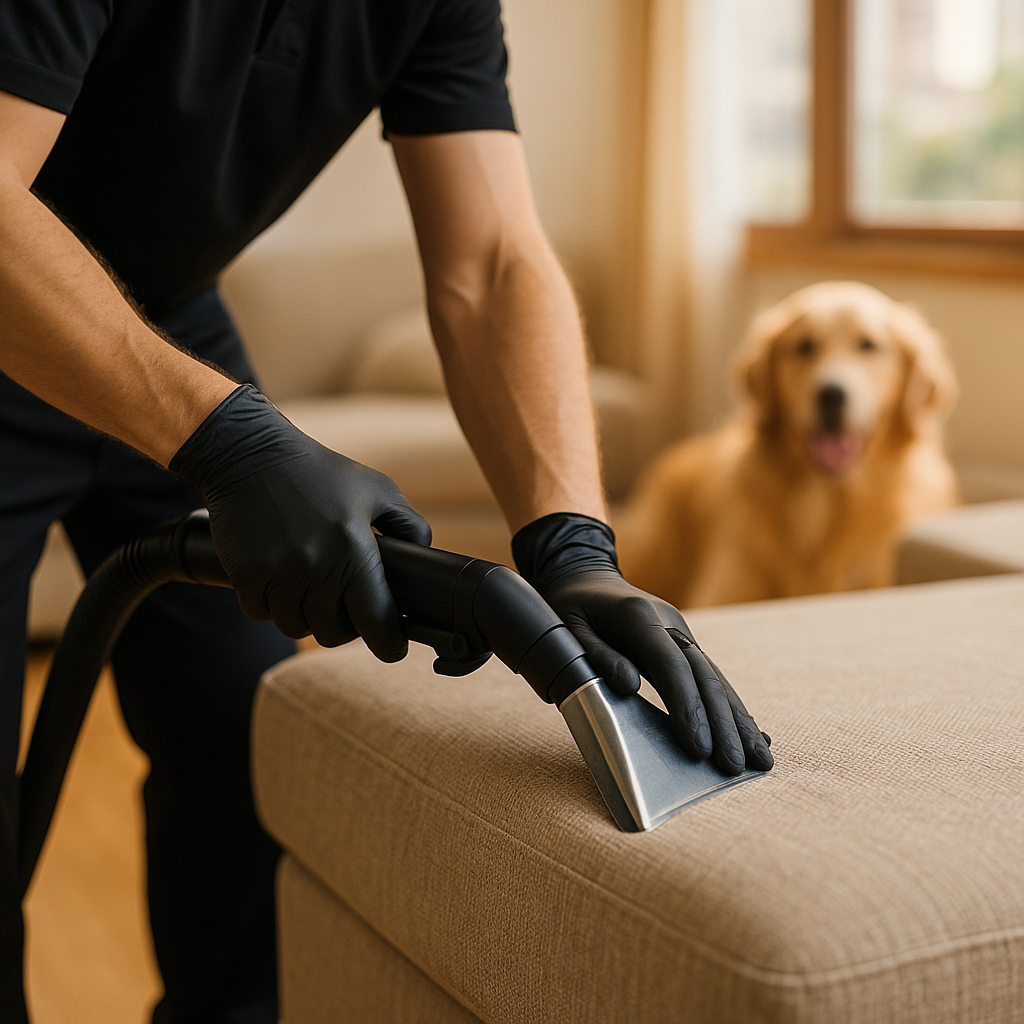
Once the pre-treatment has had time to work, we extract using hot water extraction equipment rather than simple steam — the difference matters because extraction physically pulls contaminated water, dissolved uric acid, dander, and bacteria out of the material and into our waste tank, rather than just heating the surface and letting everything resettle as it dries. For sofas, we use a specialised upholstery tool that gets into the crevices between cushions and along the base seam, which is where cat and dog odour concentrates most heavily. On carpets and rugs — which are still common in Jurong West and Punggol condos and landed homes — we make multiple slow passes to ensure the extraction reaches the backing layer, not just the pile. In our experience, a single fast pass feels satisfying in the moment but leaves enough residue behind to smell again within days, especially during Singapore’s humid afternoons when everything re-activates.
Step 4 — Treat hard surfaces, skirting, and air contact points
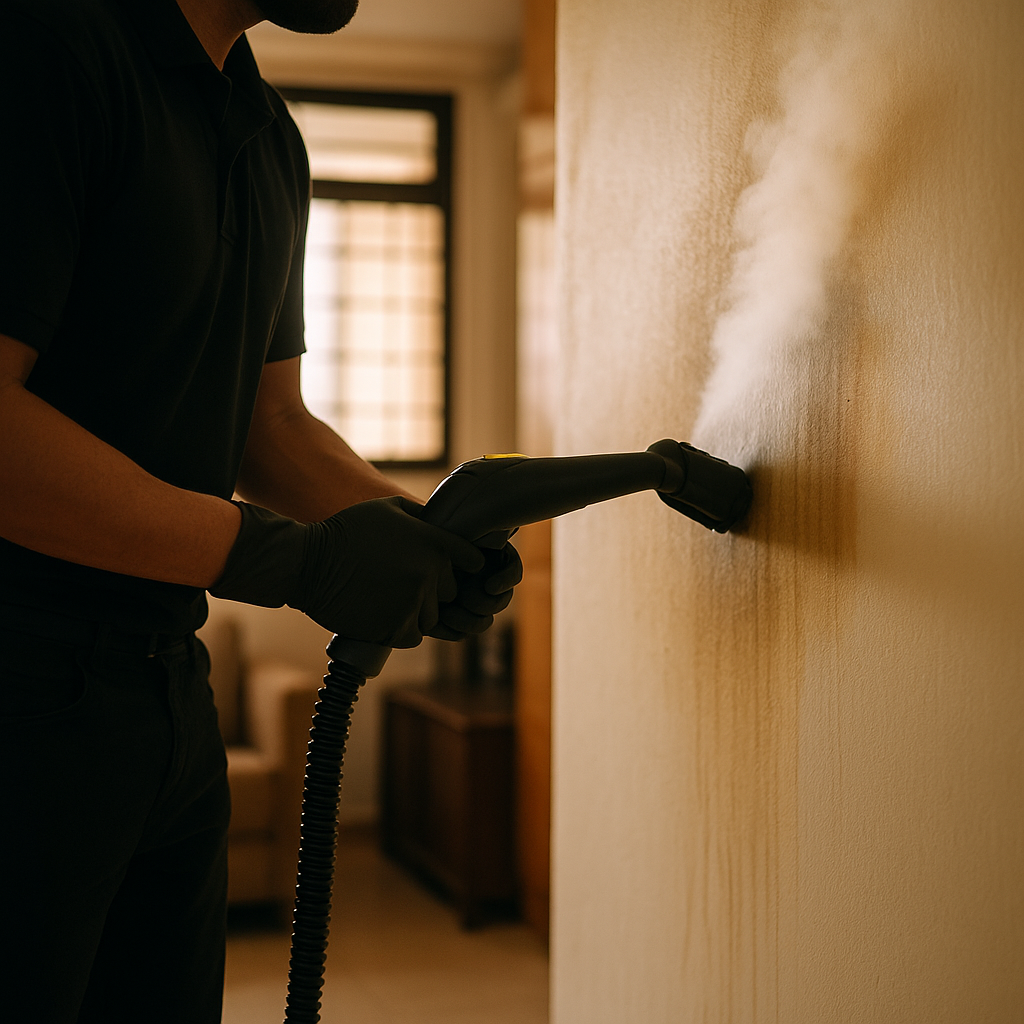
The parts of your home that accumulate pet odour silently are often the ones nobody thinks to clean: the lower 30 centimetres of your walls, the skirting boards, the underside of furniture legs, and the air-con filter housing. Dogs in particular rub their bodies along walls and furniture edges as they walk through a room, depositing oils and dander at nose height for a small animal — which is floor height for the rest of us. Our team wipes down all skirting and lower wall surfaces with an appropriate cleaner, checks the condition of your aircon filter (a badly soiled filter recirculates pet dander and odour every time the unit runs), and treats any visible soft furnishings like curtains and blinds that have absorbed ambient odour over time. In a Sengkang BTO or a Bishan HDB with all the windows closed through the wet season, the air-con system can be responsible for as much of the lingering smell as the floor itself.
Step 5 — Deodorise and restore fresh air to the space
After all surfaces have been treated and extracted, we finish with a whole-room deodorising step using an odour neutraliser rather than a fragrance masker — the goal is to chemically eliminate the remaining odour molecules, not cover them with lavender so the problem hides for a week. We also leave your windows open where safe to do so and advise you on drying time before bringing your pets back into freshly treated areas, because re-soiling a damp fabric surface within hours is one of the most common ways a cleaning job gets undone. Our team will walk you through a simple maintenance routine before we leave — not a sales pitch, just honest advice on what to do between professional cleans to keep your home smelling genuinely clean.
Why Singapore homeowners choose Doctor Clean for pet odour removal
We hear from a lot of clients who tried other options first — and we always appreciate the honest conversation about what didn’t work and why. Here’s what makes Doctor Clean different for pet-owning households in Singapore:
- Source-removal, not masking: We use enzyme and biological chemistry that breaks down uric acid and organic matter at the molecular level — your home won’t smell like artificial fragrance three days after we leave, it’ll simply smell clean.
- Pet-safe products throughout: Every product we use is selected with your animals in mind. We let you know exactly when it’s safe to let your dog or cat back onto treated surfaces, because their safety matters as much as the result.
- Trained team, consistent results: Our cleaners are trained specifically in fabric care and odour treatment — not general domestic helpers who’ve been handed a spray bottle. We’ve handled everything from single-cat HDB flats in Tampines to five-dog landed properties in Bukit Timah.
- Honest scoping and no hard sell: We tell you upfront if a surface is beyond what cleaning can fix — for example, badly soaked timber subfloor may need replacement, not just cleaning. You deserve that honesty before you spend money.
Frequently Asked Questions
How much does pet odour removal cost in Singapore?
Pricing depends on the size of your home, the number of affected surfaces, and how long the odour has been building up — a 3-room HDB with a single dog will be priced very differently from a 5-room flat with multiple cats over several years. Our quotes are itemised and transparent, so you know exactly what you’re paying for before we start. WhatsApp us with your unit type and a brief description and we’ll give you a ballpark figure quickly, usually within the hour.
Can pet urine smell ever be fully removed from HDB flooring?
In most cases, yes — especially from tiles, vinyl, and sealed laminate where the urine hasn’t had time to penetrate into the subfloor gap. If moisture has seeped under the flooring over a long period, the smell source may be in the screed or subfloor material, which requires a different approach and a more honest conversation about what cleaning alone can achieve. Our team will assess this during the walkthrough and advise you clearly rather than take your money for a result we can’t guarantee.
How long after cleaning can my pet go back on the sofa or floor?
We typically recommend waiting two to four hours for fabric surfaces to dry fully before letting your pet back on, and at least one hour for hard floors treated with biological cleaners. Rushing this step risks re-soiling a damp surface and undoing the treatment. We’ll give you specific timing based on the products used and your home’s ventilation on the day.
How often should pet owners in Singapore book a deep clean?
For active pet households — especially those with dogs that go outdoors daily — we recommend a full deep clean every three to four months, with targeted spot treatments in between as needed. Singapore’s humidity accelerates the way organic matter breaks down and produces odour, so what might be a twice-yearly clean in a drier climate often needs to be more frequent here. We offer maintenance packages for regular clients that work out to a better rate than booking individual sessions each time.
Ready to get this sorted? WhatsApp Doctor Clean — honest quote, no hard sell, fast reply.
 Doctor Clean