
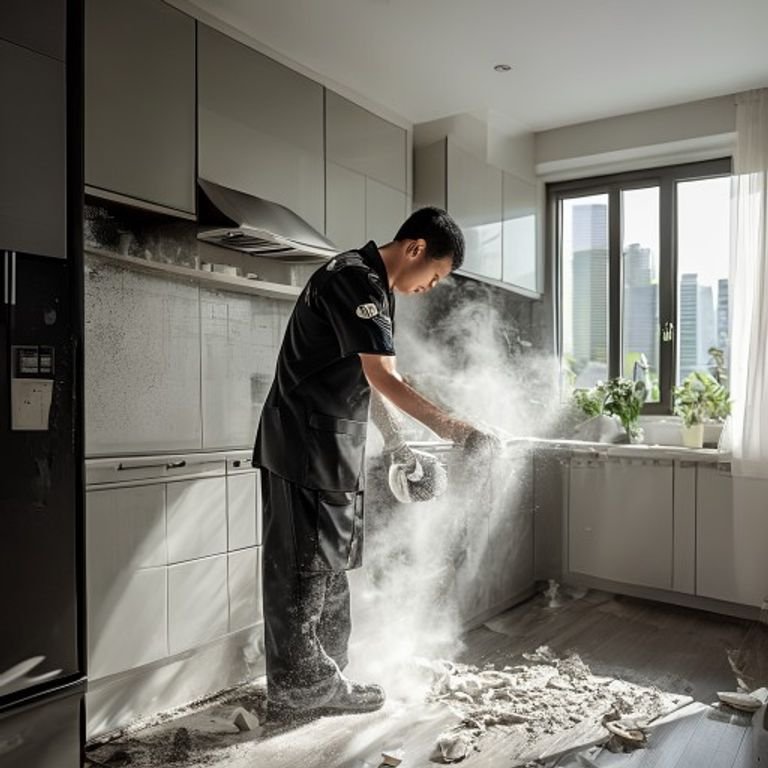
Post-renovation cleaning in Singapore is nothing like a regular tidy-up — after contractors leave, your brand-new HDB, BTO, or condo is coated in a fine layer of cement dust, silicone residue, adhesive smears, and sometimes formaldehyde fumes from fresh cabinetry and laminate. Singapore’s humidity makes it worse, locking dust onto surfaces before you even get a chance to move your furniture in. Our team at Doctor Clean has walked into hundreds of post-reno homes across the island, and every single one needs a proper, systematic approach — not just a mop and a prayer.
Step 1 — Ventilate and Assess the Full Scope
Before our team touches a single surface, we open every window and door and run a full walkthrough of the unit. We’re looking for the worst-hit zones — typically the kitchen where drilling and tiling happened, bathrooms with fresh grout, and any room where MDF or laminate carpentry was installed. This assessment tells us how long the job will take, whether formaldehyde treatment is needed, and which surfaces need chemical-grade cleaning versus careful hand-wiping. Skipping this step is how teams end up spreading dust from one room into a freshly cleaned one.
Step 2 — Remove Renovation Dust Top to Bottom

Renovation dust is the main enemy in every post-renovation cleaning job we do in Singapore. The rule our team never breaks: work from ceiling to floor, high to low, so falling dust is always captured on the next pass down.
- Ceiling cornices, light fixtures, and air-con vents — wiped with dry microfibre before any wet cleaning begins
- Walls, window frames, and door frames — damp-wiped with a neutral solution to lift cement and plaster smears
- Kitchen cabinets and carpentry interiors — vacuumed first, then wiped with a slightly damp cloth to avoid warping fresh MDF
- Floor tiles and grout lines — dry-swept, then scrubbed; grout haze from tiling is common and needs a dedicated acid-based cleaner applied carefully
- Windows and glass panels — cleaned last, since construction around them leaves silicone blobs and adhesive sticker residue that needs a blade and solvent
“One key insight from Doctor Clean — never wet-mop a post-reno floor before vacuuming thoroughly. Renovation dust turns into a paste the moment it gets wet, and it gets pushed into grout lines and tile edges where it sets hard and becomes extremely difficult to remove later.”
Step 3 — Tackle Chemical Residues and Formaldehyde
New carpentry, vinyl flooring, and laminate surfaces in Singapore homes off-gas formaldehyde — a colourless, irritating chemical that can linger for months if not treated. Our team uses professional-grade formaldehyde removal treatment on cabinets, wardrobes, and enclosed spaces where fumes concentrate. Beyond formaldehyde, we deal with silicone smears around sinks and shower screens, tile adhesive residue on floors, and paint overspray on fixtures — each of these needs a different chemical approach and careful technique to avoid scratching or staining the new surfaces your renovation was meant to protect. Rushing this step, or using the wrong solvent on the wrong surface, is how brand-new tiles and fittings end up damaged before you’ve even moved in.
Step 4 — Deep Scrub Floors and Final Surface Polish

Once dust and chemical residues are handled, our team runs a full deep floor scrubbing pass using professional rotary machines with the appropriate pad for your tile or stone type. Grout haze, dried adhesive, and plaster blobs that survived the earlier sweep get lifted at this stage — and the difference between a machine scrub and a manual mop is immediately visible. We finish by polishing all chrome fittings, wiping down every switch plate and socket cover, cleaning inside every cabinet and drawer, and doing a final window polish. The unit should be genuinely move-in ready, not just visually tidy.
Step 5 — Final Inspection and Handover
Every post-renovation cleaning job Doctor Clean completes ends with a room-by-room inspection before we hand the keys back to the homeowner. We check corners, grout lines, the insides of cabinets, the tops of door frames, and the edges of windows — the exact spots contractors miss and the spots homeowners discover two days after moving furniture in. If anything isn’t right, our team fixes it on the spot. We’ve built our reputation in Singapore on that final walkthrough, because a job that looks clean from the doorway isn’t always clean when you look closely.
Frequently Asked Questions
How much does post-renovation cleaning cost in Singapore?
Doctor Clean prices post-renovation cleaning by flat size: a 3-room HDB runs S$360–S$380, a 4-room HDB is S$400–S$430, and a 5-room HDB is S$430–S$450. For condos, a 2BR unit (around 900 sqft) starts at S$400–S$430, and a 3BR condo is S$450–S$550. Check our full pricing page for the complete breakdown, or WhatsApp us for an exact quote based on your unit’s condition.
How long does a post-renovation clean take?
For a standard 4-room HDB, our team typically needs 6–8 hours depending on the extent of the renovation and how much dust and residue the contractors left behind. Heavily renovated units with full carpentry, new tiling throughout, and fresh paintwork take longer than partial renos. We always do a proper assessment before quoting a timeframe.
Do I need formaldehyde removal after renovation?
If your renovation included new MDF cabinets, laminate wardrobes, vinyl flooring, or any flat-pack carpentry, we strongly recommend it — especially for enclosed spaces like walk-in wardrobes and kitchen cabinets where fumes concentrate. Our formaldehyde removal add-on starts from S$88 when bundled with a post-reno clean.
Can I do post-renovation cleaning myself instead of hiring a professional?
You can handle light surface dusting yourself, but the grout haze, silicone smears, adhesive residue, and formaldehyde off-gassing from carpentry genuinely require professional tools, chemicals, and technique. Most homeowners who try it themselves call us a week later after realising the dust came back and the grout lines are still grey.
How soon after renovation can I book a post-reno cleaning?
Book as soon as the contractors have fully cleared their tools and materials — ideally within a day or two of handover. The longer renovation dust sits, the more it settles into grout lines and porous surfaces, making the clean harder. Our team can usually schedule within 2–3 days of your enquiry.
Want it done properly? Doctor Clean offers professional cleaning across Singapore — WhatsApp us for an honest quote, no hard sell.
 Doctor Clean